 Welkom in Europa
IRELAND
.svg.png)
Algemene Informatie: Ierland is een eiland ten westen van Groot-Brittannië. Het grootste gedeelte van de oppervlakte van Ierland wordt ingenomen door de Ierse Republiek. Het kleinere, noordelijke deel, Noord-Ierland, behoort tot Groot-Brittannië. De oorspronkelijke naam van Ierland is Eire, maar als gevolg van de eeuwenlange Engelse overheersing is de naam Ireland, afkomstig van het oud-Engelse woord Iraland (= land van de Ieren), in gebruik gemaakt. Ierland is een dunbevolkt land. Er wonen circa 5 miljoen mensen, waarvan meer dan een miljoen in de hoofdstad Dublin en omgeving. De totale oppervlakte van het eiland Ierland bedraagt 84.421 km2 (2x Nederland). Ierland is een heuvelachtig en hier en daar bergachtig land, waar geen enkele plaats verder dan 96 km van de kust ligt. De Ierse kust is een afwisseling van kliffen, fjordachtige inhammen en stranden. In het hart van Ierland liggen de Lakelands. Dit is een merengebied met niet alleen meren, maar ook heidevlakten, grasheuvels en vele rivieren zoals de Shannon, de grootste rivier van Ierland. Ierland is onderverdeeld in vier provincies, die uit 26 graafschappen bestaan. De vier provincies zijn Ulster, Leinster, Connaught en Munster.
Hoofdstad: Dublin.
Staatsvorm: Ierland is een republiek en een parlementaire democratie. Het parlement bestaat uit twee kamers, de Dàil en de Seanad. Het staatshoofd is een direct gekozen president. De eerste minister staat aan het hoofd van de regering.
Taal: In Ierland wordt Engels gesproken, zij het met een typisch "zangerig" Iers accent. Daarnaast spreekt 13% van de Ieren de oorspronkelijke Keltische taal, het Gaelic. Gebieden waar overwegend Gaelic wordt gesproken, bevinden zich vooral in het noordwesten (de graafschappen Donegal, Mayo en Galway) en het zuiden (het graafschap Kerry).
Munteenheid: De munteenheid in Ierland is de EURO behalve in Noord Ierland dat onder Groot-Brittannië valt. Hier gebruikt men de Engelse Pond (GBP).
Religie: Van de Ierse bevolking behoort 95% tot de rooms-katholieke kerk. De overige 5% van de bevolking behoort tot de anglicaanse kerk (Anglican Church of Ireland) en enige kleinere kerkgenootschappen.
Ligging: Ierland heeft, behalve de grens met Noord-Ierland, natuurlijke grenzen. In het noorden, zuiden en westen grenst Ierland aan de Atlantische Oceaan. In het zuidoosten grenst Ierland aan het St. George's Kanaal en Keltische Zee. In het oosten aan de Ierse Zee en in het noordoosten aan de Noorder Kanaal (North Channel).
Klimaat: Ierland heeft een gematigd zeeklimaat. De winters zijn tamelijk zacht (+4 C) en de zomers heerlijk koel (tussen de 16 C en 24 C). Door de westelijke ligging aan de rand van de Atlantische Oceaan valt er veel regen, vooral in het westen. De zomers zijn echter vrij zonnig. In het zuidwesten is, door de beschutte ligging aan de voet van de bergen en onder invloed van de Warme Golfstroom, het klimaat het zachtst. In de talrijke botanische tuinen aan de zuidwestkust gedijen zelfs subtropische planten.
Beste Reistijd: Het toeristenseizoen is van eind maart tot half oktober, waarvan mei en juni, vanwege de rijkdom aan voorjaarsbloemen, de mooiste maanden voor een bezoek zijn. In het laagseizoen zijn veel hotels gesloten met uitzondering van de hotels in de grote steden.
Hoogtepunten: Dublin, Kilkenny, Killarney, Cork, Clonmacnois, Newgrange, Monasterboice, Cashel, Limerick, Galway en Westport.
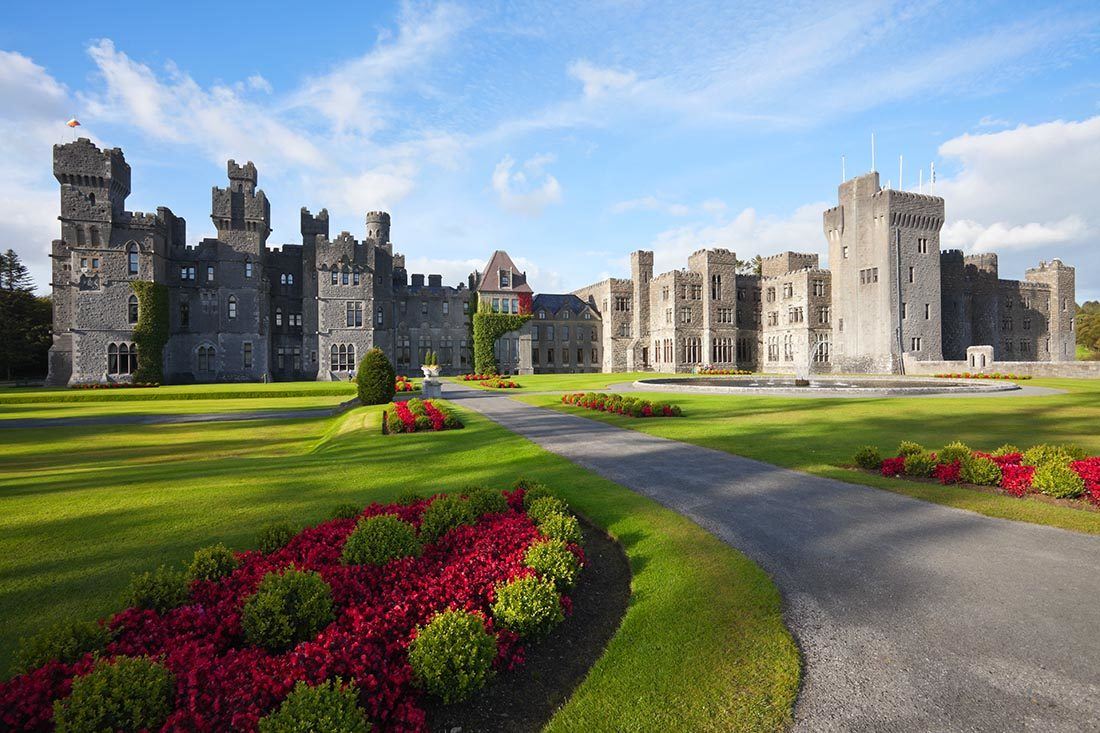
General Information: Ireland is an island west of Great Britain. Most of Ireland's land area is occupied by the Irish Republic. The smaller, northern part, Northern Ireland, belongs to Great Britain. The original name of Ireland is Eire, but due to centuries of English rule, the name Ireland, which comes from the Old English word Iraland (= land of the Irish), came into use. Ireland is a thinly populated country. Approximately 5 million people live here, of which more than a million live in the capital Dublin and the surrounding area. The total area of the island is 84,421 km2. Ireland is a hilly and in places mountainous country, with no place located further than 60 miles (96 km) from the coast. The Irish coast is a variety of cliffs, fjord-like coves and beaches. The Lakelands are located in the heart of ireland. This is a lake area with not only lakes, but also heathlands, grassy hills and many rivers such as the Shannon, Ireland's largest river. Ireland is divided into four provinces, which consist of 26 counties. The four provinces are Ulster, Leinster, Connaught and Munster.
Capital: Dublin.
Form of Government: Ireland is a republic and a parliamentary democracy. The Parliament consists of two chambers, the Dàil and the Seanad. The head of state is a directly elected president. The prime minister is the head of the government.
Language: English is spoken in Ireland, although with a typical "singing" Irish accent. In addition, 13% of Irish people speak the original Celtic language, Gaelic. Areas where Gaelic is predominantly spoken are mainly in the northwest (counties Donegal, Mayo and Galway) and the south (county Kerry).
Currency: The currency in Ireland is the EURO except in Northern Ireland which is part of Great Britain. The English Pound (GBP) is used here.
Religion: Of the Irish population, 95% belong to the Roman Catholic Church. The remaining 5% of the population belongs to the Anglican Church (Anglican Church of Ireland) and some smaller church societies.
Location: Ireland has natural borders, except for the border with Northern Ireland. Ireland borders the Atlantic Ocean in the north, south and west. In the southeast, Ireland borders the St. George's Channel and the Celtic Sea. In the east on the Irish Sea and in the northeast on the North Channel.
Climate: Ireland has a temperate maritime climate. The winters are quite mild (+4 C/39.2 F)) and the summers are wonderfully cool (between 16 C and 24 C/60.8 F and 75.2 F). Due to its western location on the edge of the Atlantic Ocean, there is a lot of rain, especially in the west. However, the summers are quite sunny. The climate is the mildest in the southwest, due to its sheltered location at the foot of the mountains and under the influence of the Warm Gulf Stream. Subtropical plants even thrive in the numerous botanical gardens on the southwest coast.
Best time to visit: The tourist season is from late March to mid-October, with May and June being the most beautiful months for a visit due to the wealth of spring flowers. In the low season, many hotels are closed, with the exception of hotels in the major cities.
Highlights: Dublin, Kilkenny, Killarney, Cork, Clonmacnois, Newgrange, Monasterboice, Cashel, Limerick, Galway en Westport.
@MK
