 Welkom in Europa
LUCCA
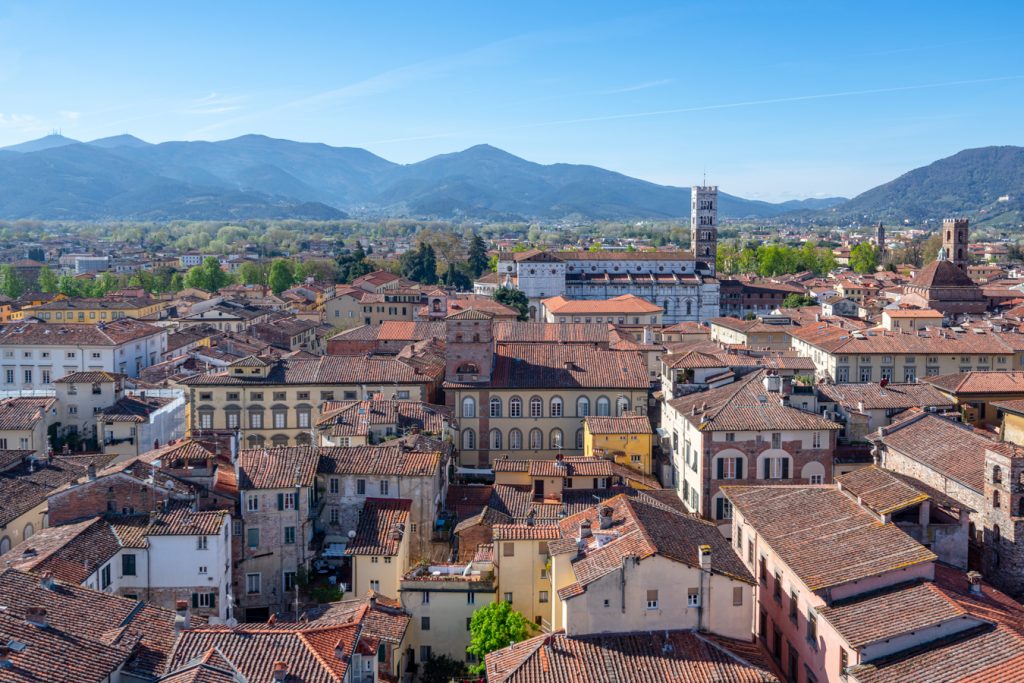
BEZIENSWAARDIGHEDEN / HIGHLIGHTS

Bezienswaardigheden / tips Lucca 2025:
1) Lucca: Lucca is een vredige stad, omgeven door met bomen begroeide wallen, heeft de bezoeker nog steeds sfeervolle piazza's, kerkjes, musea en straten met klinkerstenen te bieden. Alle belangrijke bezienswaardigheden bevinden zich in het stadscentrum, binnen de oude wallen. Het strakke stratenplan van Lucca dateert nog uit de Romeinse tijd. In de middeleeuwen kwam de stad tot bloei dankzij de zijdehandel; lingerie is nog steeds een belangrijke bedrijfstak in Lucca. Vanaf de 14e eeuw verloor de stad aan invloed, maar bleef onafhankelijk tot de komst van Napoleon. De Bourbons zwaaiden hier de scepter tot de Italiaanse eenwording. Naast Florence en Siena is er geen mooiere Toscaanse stad dan Lucca. Een bezoek is daarom zeer de moeite waard.
2) Piazza Anfiteatro: Het Piazza dell'Anfiteatro (ook bekend als Piazza del Mercato) is het bekendste plein in Lucca. Het plein is gebouwd op, en herinnert met zijn naam aan, een vroeger gelegen Romeins amfitheater. Door de eeuwen heen werd de plek van het theater uiteindelijk volledig volgebouwd met huizen. Aan het plein zijn tegenwoordig voornamelijk horecagelegenheden te vinden. In de zomermaanden staat een groot deel van het plein vol met terrassen. Het plein kan alleen bereikt worden door onder een van de vier arcades door te gaan. Het plein is hierdoor ook grotendeels autovrij.
3) San Michele in Foro: De naam van de kerk van San Michele in Foro betekent dat hij naast het Romeinse forum staat. Het forum was vroeger het stadsplein en doet nog steeds als zodanig dienst. De San Michele in Foro is een van de vele kerken van Lucca die gebouwd zijn in de 12de en 13de eeuw in de uitbundige Pisaans-romaanse stijl. De entree is gratis.
4) Torre dei Guinigi: Casa Guinigi is een middeleeuwse stadshuis van de familie Guinigi, de belangrijkste adellijke familie van Lucca. Het staat vooral bekend om zijn hoge toren (die een prachtig uitzicht over de stad biedt) en de steeneiken op het dak. De entree tot de toren kost 5,00 EURO. Een bezoek is zeker de moeite waard!
5) Historische stadswallen: De beroemde met bomen omzoomde stadsmuren zijn gebouwd in 1504-1645 en zijn 12 meter hoog en 25 meter breed en bieden een prachtig uitzicht op Lucca en de heuvels en vlaktes. De stadswallen zijn in een lus gebouwd en er is een wandel en fietspad van 4,9 km lang. Er zijn genoeg aanbieders waar je fietsen kunt huren. Een rit met de fiets is zeer de moeite waard en je ziet meer van de wijde omtrek.
6) Duomo di San Martino: De bijzondere kathedraal van Lucca, met zijn facade die tegen de campanile is aangebouwd, is gewijd aan St. Martinus. Hij is de Romeinse soldaat op de voorgevel die zijn mantel met een zwaard in tweeën deelt om de helft aan een bedelaar te geven. Deze en andere scènes uit het leven van de heilige maken deel uit van de complexe decoraties op de 13de eeuwse gevel. Verder zie je de reliëfs 'De werken van de maanden' en panelen van ingelegd marmer met jachttaferelen, pauwen en bloemen. De entree is niet gratis.

Highlights / tips Lucca 2025:
1) Lucca: Lucca is a peaceful city, surrounded by three-lined ramparts, still offering the visitor atmospheric piazzas, churces, museums and cobbled streets. All the main sights are located in the city center, within the old ramparts. Lucca's strict street plan dates back to Roman times. In the Middle Ages, the city flourished thanks to the silk trade; lingerie is still an important industry in Lucca. From the 14th century the city lost its influence, but remained independent until the arrival of Napoleon. The Bourbons sway the scepter until the Italian unification. Apart from Florence and Siena, there is no more beautiful Tuscan city than Lucca. A visit is therefore well worth it.
2) Piazza Anfiteatro: Piazza dell'Anfiteatro (also known as Piazza del Mercato) is the most famous square in Lucca. The square is built on, and is named after, a former Roman amphitheatre. Over the centuries, the site of the theater was eventually completely built up with houses. Nowadays, the square mainly houses restaurants. In the summer months, a large part of the square is full of terraces. The square can only be reached by passing under one of the four arcades. The square is therefore largely car-free.
3) San Michele in Foro: The name of the church of San Michele in Foro means it stands next to the Roman Forum. The forum used to be the town square and still serves as such today. The San Michele in Foro is one of Lucca's many churches built in the 12th and 13th centuries in the exuberant Pisan-Romanesque style. The entrance is free.
4) Torre dei Guinigi: Casa Guinigi is a medieval town house of the Guinigi family, the most important noble family of Lucca. It is best known for its high tower (which offers a beautiful view of the city) and the holm oaks on the roof. The entrance to the tower costs 5.00 EURO. A visit is definitely really worth it.
5) Historic city walls: Built in 1504-1645, the famous tree-lined city walls are 12 meters (39 feet) high and 25 meters (82 feet) wide and offer wonderful views of Lucca and the hills and plains. The city walls are built in a loop and there is a walking and cycling path of 4.9 km (3 miles) long. There are plenty of providers where you can rent bicycles. A ride by bike is very worthwhile since you can see more of the area
6) Duomo di San Martino: Lucca's remarkable cathedral, with its facade curiously built against the campanile, is dedicated to St Martin. On the facade stands St. Martin a Roman soldier who divides his cloak with a sword and gave half to a beggar. These and other scenes from the saint's life are part of the intricate decorations on the 13th century facade. You can also see the reliefs 'The works of the months' and panels of inlaid marble with hunting scenes, peacocks and flowers. The entrance is not free.
.jpg)
(2).jpg)
Lucca werd in 180 v.C. een kolonie van het oude Rome, en de Romeinse erfenis is nog steeds zichtbaar aan het rechthoekige stratenpatroon. (op de bovenste foto Porta San Gervasio).
Lucca was established in 180 B.C. a colony of ancient Rome, and the Roman legacy is still evident in the rectangular street pattern. (above on top Porta San Gervasio).
.jpg)
.jpg)
Er is bijna geen steen meer over van het oude Romeinse amfitheater: ze werden gestolen en elders gebruikt, waarna het sfeervolle, arenavormige Piazza del Mercato (ook bekend onder de naam Piazza dell' Anfiteatro) overbleef.
Hardly any stone remains of the ancient Roman amphitheatre: they were stolen and used elsewhere, leaving the atmospheric, arena-shaped Piazza del Mercato (also known as Piazza dell' Anfiteatro).
.jpg)
.jpg)
Het plein wordt omgeven door middeleeuwse huizen. Ze werden rond de muren van het amfitheater gebouwd en bewaarden daarmee perfect zijn vorm.
The square is surrounded by medieval houses. They were built around the walls of the amphitheater, perfectly preserving its shape.
.jpg)
.jpg)
Een treffende herinnering aan het feit dat Lucca in 180 v.C. door de Romeinen werd gesticht. Lage doorgangen geven de poortjes aan waar beesten en gladiatoren het strijdperk betraden.
A reminder of the fact that Lucca was founded by the Romans in 180 B.C. Low passages indicate the gates where beasts and gladiators entered the arena.
.jpg)
De basiliek van San Frediano (hier op de foto) is een romaanse kerk op de Piazza San Frediano. Frediano was de Ierse bisschop van Lucca in de eerste helft van de zesde eeuw. Hij liet op deze plaats een eenvoudige kerk bouwen gewijd aan San Vincenzo, een martelaar uit Saragossa in Spanje.
The Basilica of San Frediano (pictured here) is a Romanesque church in Piazza San Frediano. Ferdiano was the Irisch bishop of Lucca in the first half of the sixth century. He had built a simple church, dedicated to San Vincenzo, a martyr from Saragossa in Spain.
.jpg)
De Duomo di San Martino, op de piazza San Martino, heeft een mooie facade (1060-1241). Bijzonder mooi is het 13e-eeuwse sculptuurwerk rond het atrium en de toegangspoort.
The Duomo di San Martino, on the piazza San Martino, has a beautiful facade (1060-1241). Particularly beautiful is the 13th-century sculpture around the atrium and entrance gate.
.jpg)
(2).jpg)
San Michele in Foro is gebouwd op de plaats van het voormalige Romeinse forum. De adembenemende facade in Pisaans-romaanse stijl is gedecoreerd met marmerstrepen en rijen kleine loggia's blinde bogen en gedraaide zuiltjes.
San Michele in Foro is built on the site of the former Roman forum. The breathtaking Pisan-Romanesque facade is decorated with marble stripes and rows of small loggias, blind arches and twisted columns.
.jpg)
.jpg)
De facade, waaraan men 260 jaar werkte, slorpte zoveel geld op dat er weinig overbleef voor het interieur. Dit is dan ook tamelijk sober, maar er is wel een bijzondere schildering van heiligen te zien: Vier heiligen, te weten Hiëronymus, Sebastiaan, Rochus en Helena (1483), geschilderd door Filippino Lippi.
The facade, on which they worked for 260 years, absorbed so much money that little was left for the interior. This is therefore rather sober, but there is a special painting of saints to be seen: Four Saints, namely Jerome, Sebastian, Rochus and Helena (1483), painted by Filippino Lippi.
(2).jpg)
De binnenkant van San Michele in Foro.
The interior of San Michele in Foro.
.jpg)
.jpg)
Piazza San Francesco, in het noordoostelijke deel van het historische centrum op een steenworp afstand van de belangrijkste straten en monumenten, is een minder bekende en drukke plaats, maar even rijk aan geschiedenis. Het plein dankt zijn naam aan de kerk van San Francesco, gebouwd in 1228. (zie film).
Piazza San Francesco, in the northeastern part of the historic center is just a few steps away from the main streets and monuments, and is less known and busy but just as rich in history. The square owes its name to the Church of San Francesco, built in 1228. (see film).
.jpg)
Op een slanke Korinthische zuil staat een prachtig beeld van de Madonna (Colonna della Madonna dello Stellario) in barokstijl, het werk van de beeldhouwer Giovanni Lazzoni, bovenop geplaatst in 1687. Op de basis is er een zeventiende-eeuws uitzicht op Lucca. (zie film).
On a slim Corinthian colum stand a beautiful Baroque-style statue of the Madonna (Colonna della Madonna dello Stellario), the work of the sculptor Giovanni Lazzoni, placed on top in 1687. On the base there is a seventeenth-century view of Lucca. (see film).
(2).jpg)
Het plein Piazza del Giglio met het standbeeld van Garibaldi.
The square Piazza del Giglio with the statue of Garibaldi.
.jpg)
.jpg)
Lucca is een mooie verzorgde stad met prachtige onderhouden perken en bloemen.
Lucca is a beautiful, well-kept city with beautifully maintained beds and flowers.
.jpg)
.jpg)
Lucca is omgeven door zware muren van rode baksteen. Doordat ze het verkeer en de moderne wereld buitensluiten, geven ze de stad zijn speciale karakter. (zie film).
Lucca is surrounded by heavy walls of red brick. By shutting out traffic and the modern world, they give the city its special character. (zie film).
.jpg)
.jpg)
De muren zijn gebouwd tussen 1504 en 1645 en behoren tot de best bewaarde verdedigingswerken uit de renaissance. (zie film).
The walls were built between 1504 and 1645 and are among the best preserved fortifications from the Renaissance. (see film).
(2).jpg)
.jpg)
Binnen deze muren is Lucca een vredige stad van nauwe straatjes die nog volgens het oude Romeinse stratenplan zijn aangelegd. Lucca is vlak en veel bewoners rijden dan ook op de fiets.
Within these walls, Lucca is a peaceful city of narrow streets that are built according to the old Roman street plan. Lucca is flat and many residents ride their bicycles.
@MK
